Labradoodle
A sociable, clever crossbreed that pairs the Labrador's warmth with the Poodle's brains and low-shedding tendency.
About the Labradoodle
The Labradoodle is a designer crossbreed created by mating a Labrador Retriever with a Poodle. It was first popularized in Australia in the late 1980s by Wally Conron, a breeding manager at the Royal Guide Dogs association, who was trying to produce a guide dog suitable for a blind woman whose husband was allergic to dog hair. Conron crossed a Labrador with a Standard Poodle hoping to combine the Labrador's steady, trainable temperament with the Poodle's low-shedding coat. The name and the idea caught on quickly, and the Labradoodle became one of the first widely known “doodle” crosses.
It is important to distinguish the two things people mean by “Labradoodle.” A first-generation (F1) Labradoodle is a straightforward Labrador-to-Poodle cross, and such dogs vary enormously from litter to litter in coat, size, and shedding. Over time, breeders in Australia worked to stabilize the type by breeding Labradoodle to Labradoodle across multiple generations, sometimes adding other breeds, to create the more predictable Australian Labradoodle. Multi-generational dogs tend to be more consistent in coat and temperament than a first cross, but there is still natural variation, and no Labradoodle is a recognized purebred.
In temperament the Labradoodle is typically friendly, social, playful, and eager to please, which makes it a popular family companion and a candidate for therapy and assistance work. It is an intelligent dog that generally trains well, but it is not a low-energy lap dog: most Labradoodles have real exercise needs and can become bored, anxious, or destructive without enough activity and mental stimulation. The Labradoodle is a cross, not an AKC-recognized breed, so buyers should judge each dog and breeder on their merits rather than assume a fixed standard.
Breed Characteristics
- Stamina Level: Moderate to high — an active dog that needs daily exercise
- Grooming: High; the coat mats and needs regular brushing plus professional grooming
- Training Ease: Very good — intelligent, social, and eager to please
- Size: Varies widely (miniature, medium, and standard; roughly 15–65 lbs depending on the Poodle used)
- Temperament: Friendly, affectionate, playful, and people-oriented
Care Requirements
Plan on giving a Labradoodle genuine daily activity — brisk walks, fetch, swimming, or off-leash running — alongside mental work such as training games, puzzle feeders, or scent play. Because both parent breeds are clever and active, an under-exercised Labradoodle often channels its energy into chewing, digging, barking, or nervous behavior. Their eager, biddable nature makes positive-reinforcement training productive and rewarding.
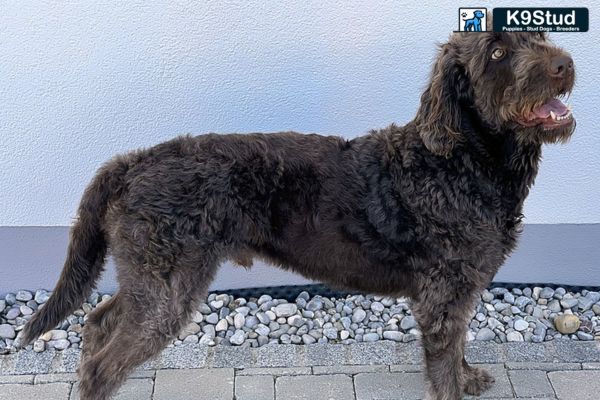
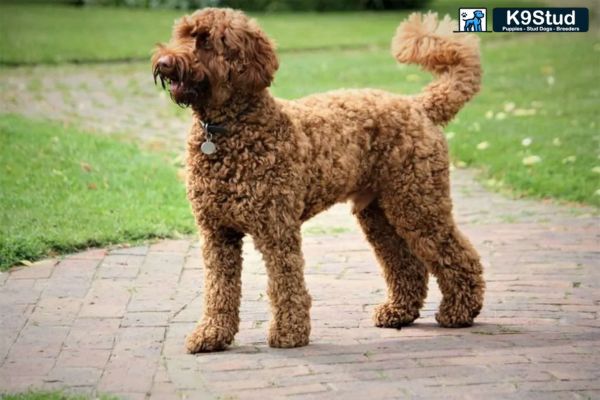
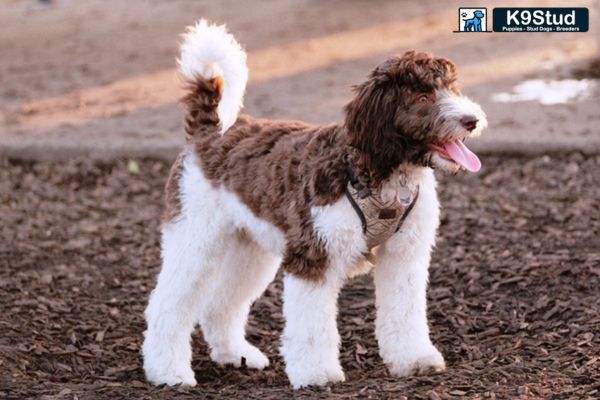
Coat care is the biggest ongoing commitment. Labradoodle coats vary widely — described as hair, fleece, or wool — and “low-shedding” or “hypoallergenic” is a tendency, not a guarantee, especially in first-generation dogs. The fleece and wool coats mat readily, so brush several times a week and schedule professional grooming every six to eight weeks. Because the Labradoodle is a cross, health depends on testing of both parents: look for hip and elbow evaluations, eye clearances for conditions such as progressive retinal atrophy (PRA), and DNA tests for exercise-induced collapse (EIC) and Addison's disease.